Notes, fragments, and books I've made, straight from the person behind the machine.
📌 MakerThe Interview
What the Biography Machine actually is, in 100 seconds
Uldis Gabriel · 08 Aug 2026
People kept asking what exactly happens here, so I filmed it: you talk with the machine, it interviews you, and it writes your real printed autobiography. Every fact from your own words, and you approve every chapter before print.
No comments yet, say something kind.
📌 MakerThe Interview
How a two-hour conversation becomes a 150-page book
Biography Machine · 20 Jul 2026
You sit down with a cup of coffee and start talking. Two hours later, the machine has everything it needs to begin writing a 150-page book. People ask how that is possible, so here is the honest anatomy of it.
THE CONVERSATION. There is no questionnaire. The machine opens gently, something light, never the heavy things first, and follows your energy rather than a script. When you mention your father's workshop in passing, it notices, and twenty minutes later it asks what the workshop smelled like. That one question can unlock a whole chapter.
WHAT TWO HOURS ACTUALLY CONTAINS. People overestimate how much time a life needs. A relaxed two-hour conversation produces roughly 15,000 of your own words, and inside them, usually forty to sixty distinct scenes: the move, the first job, the night everything changed. The machine maps every one of them while you talk. You see them appear, live, like snapshots developing.
THE ORGANISING. Here is the part that surprises everyone: the book is not chronological. Life makes sense by theme, not by date. The machine groups your scenes by inner development, the thread about courage, the thread about your mother, the thread about leaving, so a moment at seven and a moment at fifty-two can sit in the same chapter and explain each other.
THE WRITING. Every line is built from what you actually said. Nothing is invented; where the machine adds a connecting detail, it is marked for your review so you can replace it with the real memory. Your vocabulary, your humour, your way of talking, that is the voice on the page, just given structure and rhythm.
THE CHECK. Before anything is printed, the machine fact-checks the manuscript against your own transcript and hands you a review sheet: keep, fix, or cut. You approve every page. The final say is always yours.
Then it is printed, bound, and posted to your door. Two hours of talking. A book your grandchildren will hold.
Most people, somewhere in the first half hour, stop noticing they are talking to a machine at all. That is when the real book begins.
No comments yet, say something kind.
📌 MakerThe Interview
Most of my life, I don't remember at all
Lynn · 20 Jul 2026
Lynn is writing her autobiography with Biography Machine. A few weeks in, she recorded this.
What she describes is the thing almost nobody expects. It isn't that remembering is hard. It's that most of a life is genuinely, permanently gone: the commutes, the dinners, the ordinary Tuesdays. What's left is a handful of scenes, and even those shift a little each time you take them out and look at them.
Her conclusion isn't sad, though. It's practical. Go and make memories worth keeping. Then get them written down while you still have them.
No comments yet, say something kind.
📌 MakerThe Book I Made
How it worked with me?
Uldis · 09 Jul 2026
Making my book was not as easy as I expected. I thought I would just answer a few questions and receive a memoir, like ordering a sandwich,.
The first night I talked for two hours. The next days, less, because even my ego apparently has battery limits. Some questions made me laugh. Some brought me to tears. Some made me tired in that very elegant way where you stare at the wall and reconsider your entire personality.
And then, suddenly, I had my book. This ir the best part!
Book is on the way to Gaucin.
Reading what I created with my stories .... it was strange. I saw my life differently. Not as random something with silly confidence, but as one clear drive: always running toward freedom, building worlds, escaping the ordinary, and slowly discovering that what I was really looking for had been beside me all along.
Very rude of my 60 programmed agents to understand me better than I did.
No comments yet, say something kind.
📌 MakerThe Interview
How to Turn a Life Into a Book Without Killing the Person During the Interview
Uldis Cipsts · 07 Jul 2026
I created Biography Machine because the world is full of people with ridiculous, beautiful, tragic, heroic, embarrassing, completely unbelievable lives — and almost nobody knows about them. Not because these people are boring. Usually the opposite. They have survived marriages, countries, children, bankruptcies, miracles, stupid decisions, brilliant decisions, family legends, private wars, romantic disasters, and at least three moments where any reasonable screenwriter would say, “No, this is too much.” And still, when asked to tell their life story, most people say something deeply useful like: “Well… I was born.”
So I thought: fine. Let’s build a machine that can actually pull the story out. Easy. A person talks, AI listens, a beautiful biography appears. What a clean, elegant idea. Naturally, it was a nightmare. Because even the most modern AI can summarize words, but a life is not a tax document with childhood trauma. It has emotional background, character development, broken chronology, five people with the same name, one uncle nobody can explain, and a main character who usually has no idea what the plot was until thirty years later.
The hardest part was balance. If the machine pushes too hard, it feels like a police interrogation conducted by a therapist who also teaches algebra. If it becomes too gentle, everyone has a lovely conversation, feels emotionally seen, and produces absolutely nothing resembling a book. Charming? Yes. Useful? Adorable, but no.
And then came the structure. Oh, the structure. Behind Biography Machine there are around sixty AI agents, each doing its own tiny obsessive job, because apparently one artificial intelligence was not enough — I had to build a whole nervous system. One follows the timeline. One watches emotional truth. One checks names and places. One looks for missing scenes. One tries to understand who the person really is. Another probably sits somewhere in the dark, quietly judging everyone’s life choices.
All of them work together behind the scenes, following rules about what to ask, what to notice, what not to invent, how to connect memories, and how to turn a spoken mess into something with rhythm, structure, tension, personality, and actual chapters. Basically, a writers’ room, but without cigarettes, egos, divorces, or anyone pretending the third act is “almost there.”
I know this is probably nothing. Humanity has invented cinema, airplanes, antibiotics, and self-checkout machines that still need staff intervention every nine seconds. But for me, Biography Machine feels like a small masterpiece. It is built from my film directing experience — from years of looking at chaos and trying to find the story inside it: the gesture, the wound, the joke, the silence, the moment where a person accidentally reveals the whole movie.
Biography Machine is not here to make people sound important.
That would be vulgar.
It is here to prove that most people already are — they just needed someone, or something slightly insane, to listen properly.
No comments yet, say something kind.
Stories from everyone
Fragments
A train to grandmother's house, every summer
Uldis Gabriel · 18 Aug 2026
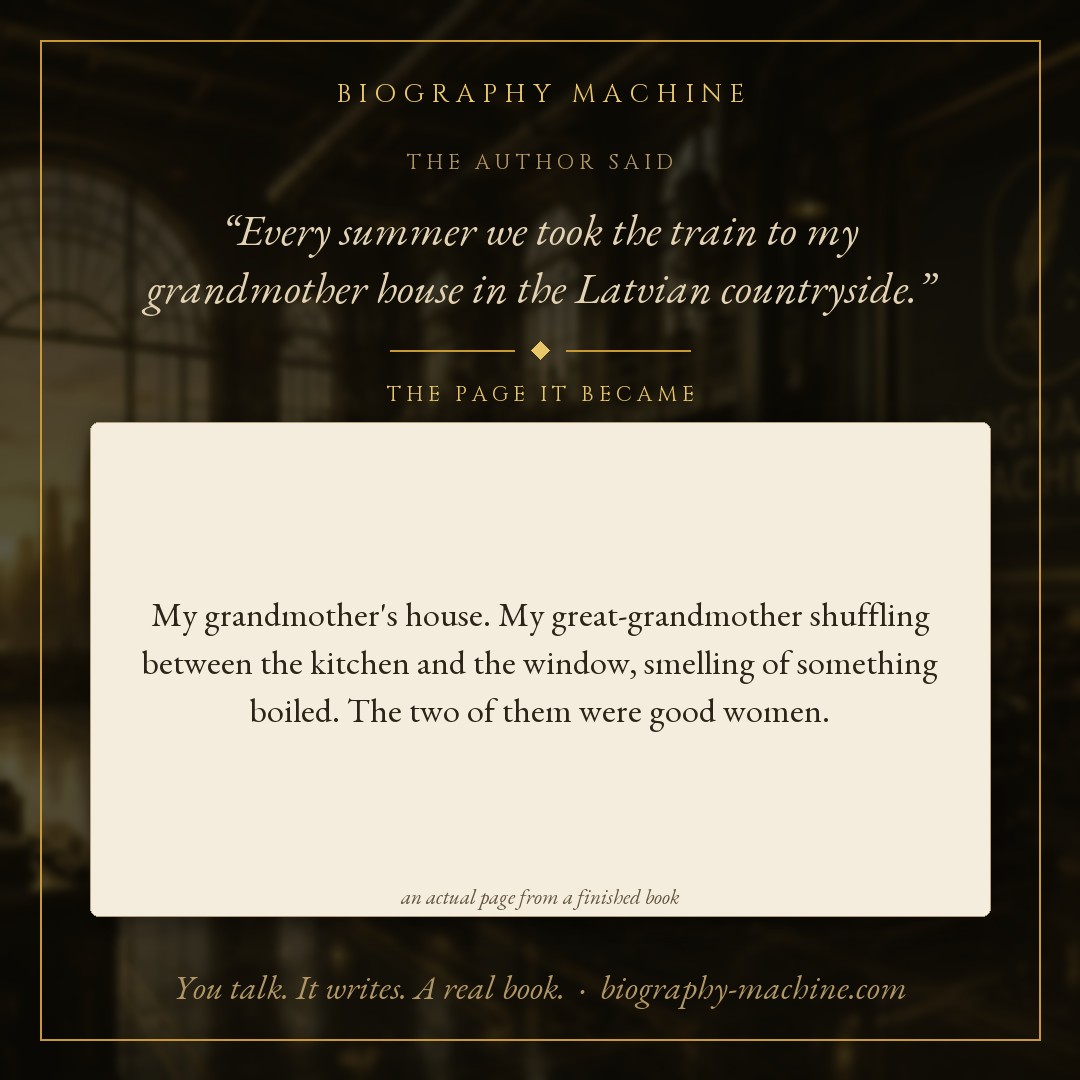
A train to grandmother's house, every summer.
Five words in conversation became a page you can hold: the great-grandmother by the window, the smell of something boiled, two good women.
Someone in your family is carrying pages like this right now.
You talk. It writes. A real printed book.
biography-machine.com
Both sides are verbatim: what the author said in the interview, next to the page in the finished book. Nothing invented.
No comments yet, say something kind.
Fragments
History looks different from inside a kitchen
Uldis Gabriel · 18 Aug 2026
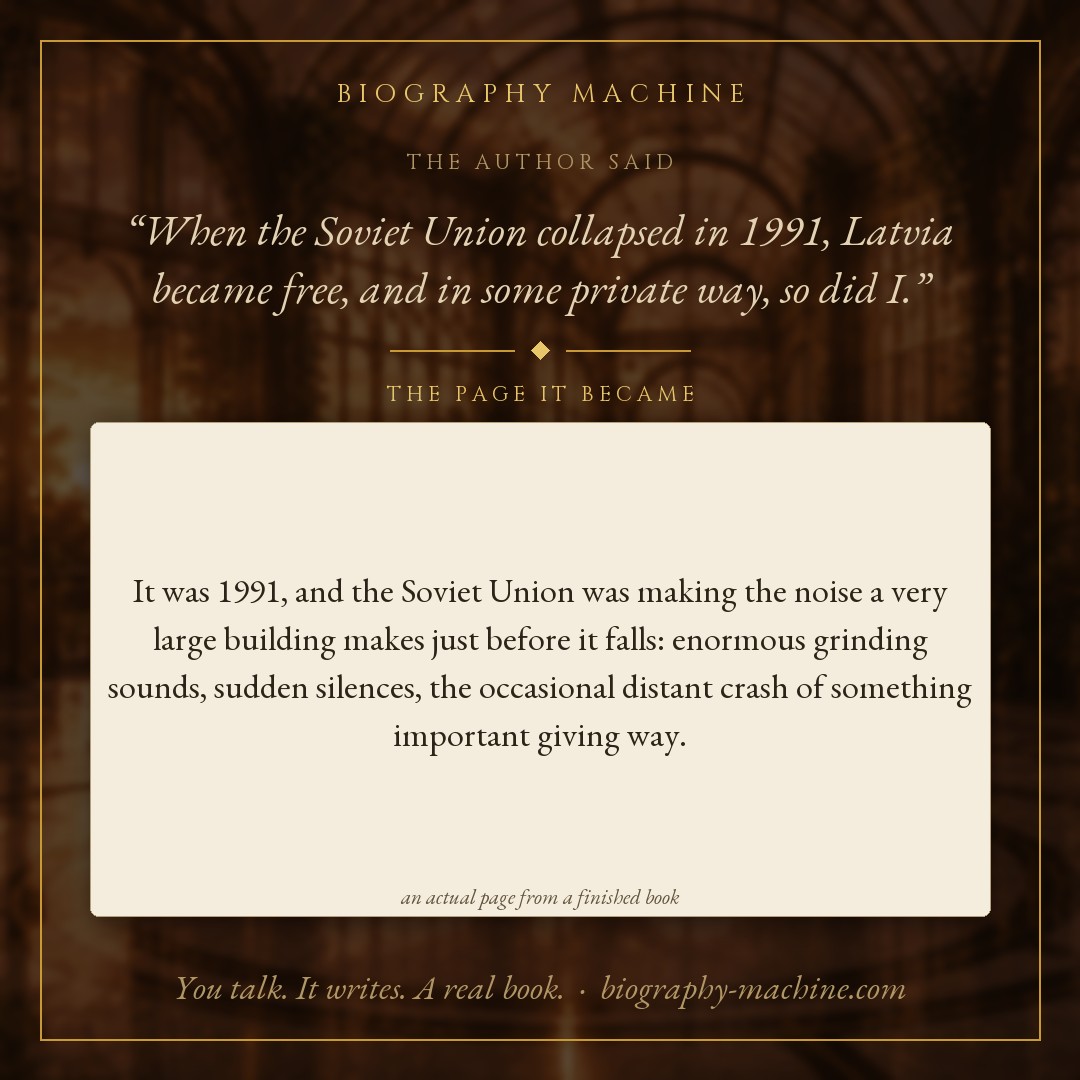
History looks different from inside a kitchen.
He mentioned 1991 in one sentence. The book wrote the sound of an empire falling, heard by a fifteen-year-old at breakfast.
Your life happened inside history. Both belong in your book.
biography-machine.com
Both sides are verbatim: what the author said in the interview, next to the page in the finished book. Nothing invented.
No comments yet, say something kind.
Fragments
Everyone loved my little brother more than me
Uldis Gabriel · 18 Aug 2026
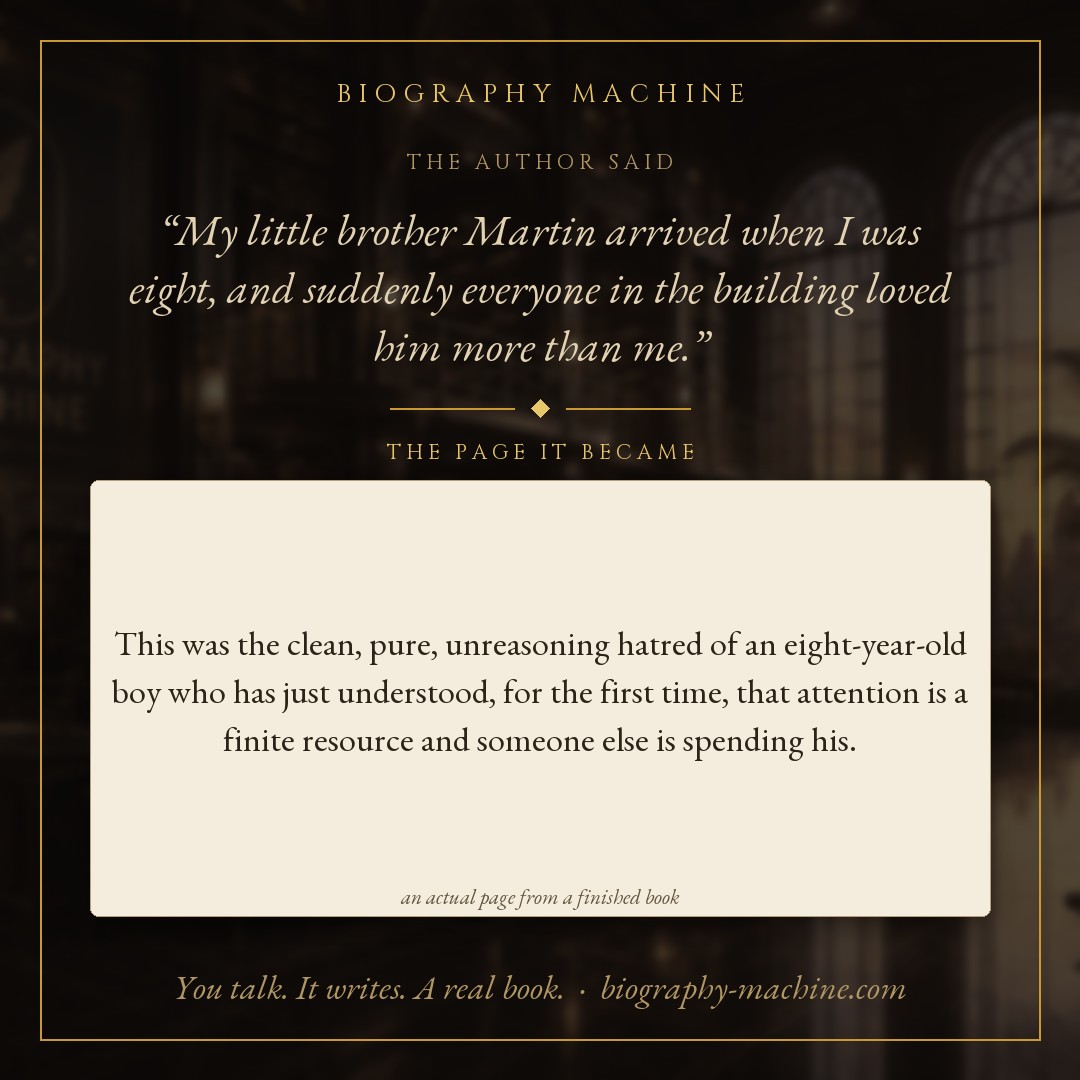
"Everyone loved my little brother more than me."
Every family has this sentence. The machine turns it into a chapter about attention, jealousy, and being eight years old.
The book is written from your words, in your voice, and you approve every page.
biography-machine.com
Both sides are verbatim: what the author said in the interview, next to the page in the finished book. Nothing invented.
No comments yet, say something kind.
Fragments
A broken bottle of ammonia, two boys, no adults home
Uldis Gabriel · 18 Aug 2026
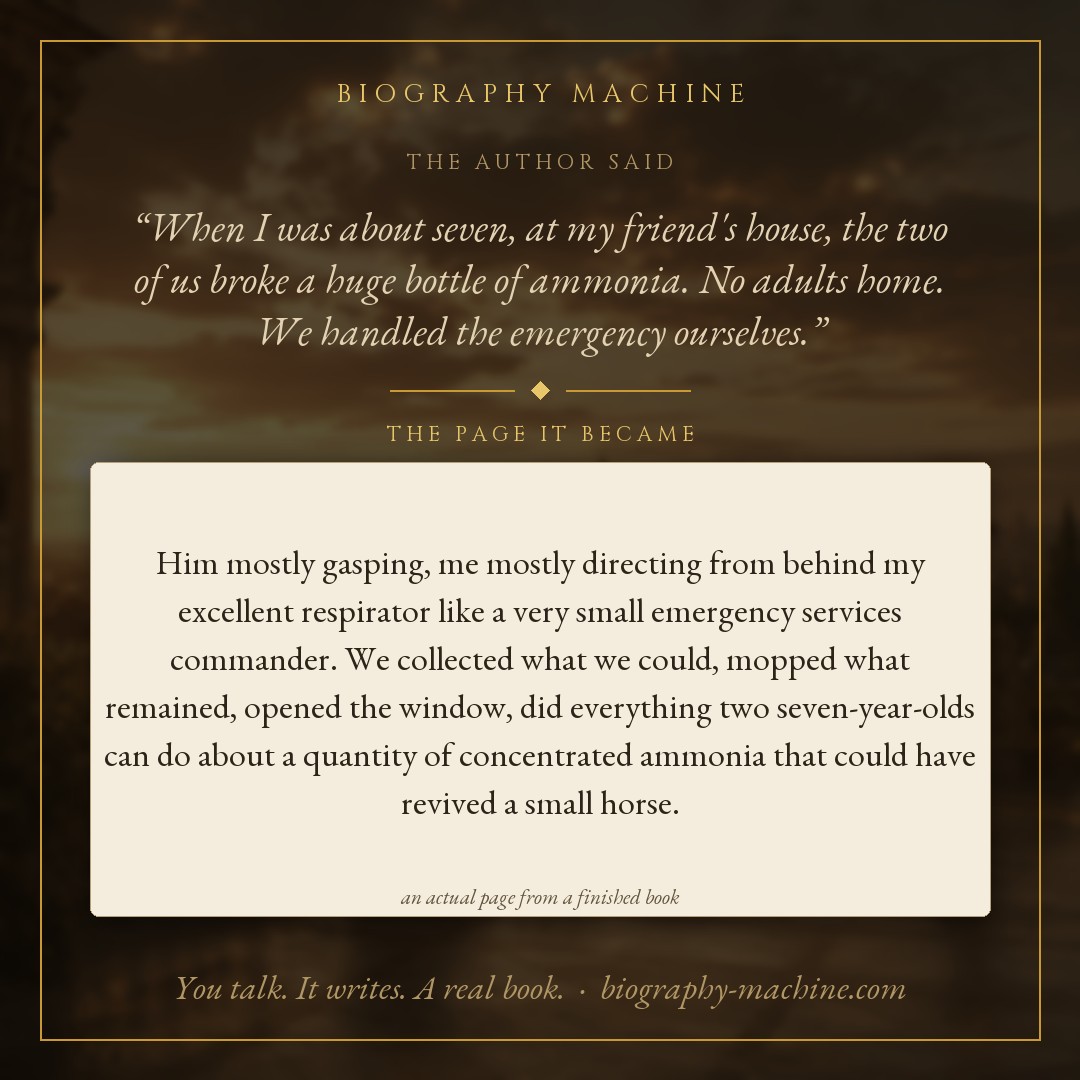
One spoken memory about a broken bottle of ammonia at a friend's house.
The book made it a scene: two seven-year-olds doing everything they can about a chemical spill that could have revived a small horse.
Your funny stories deserve better than being forgotten.
You talk. It writes. A real printed book.
biography-machine.com
Both sides are verbatim: what the author said in the interview, next to the page in the finished book. Nothing invented.
No comments yet, say something kind.
Fragments
A mother born in a Siberian prison, and the page it became
Uldis Gabriel · 18 Aug 2026
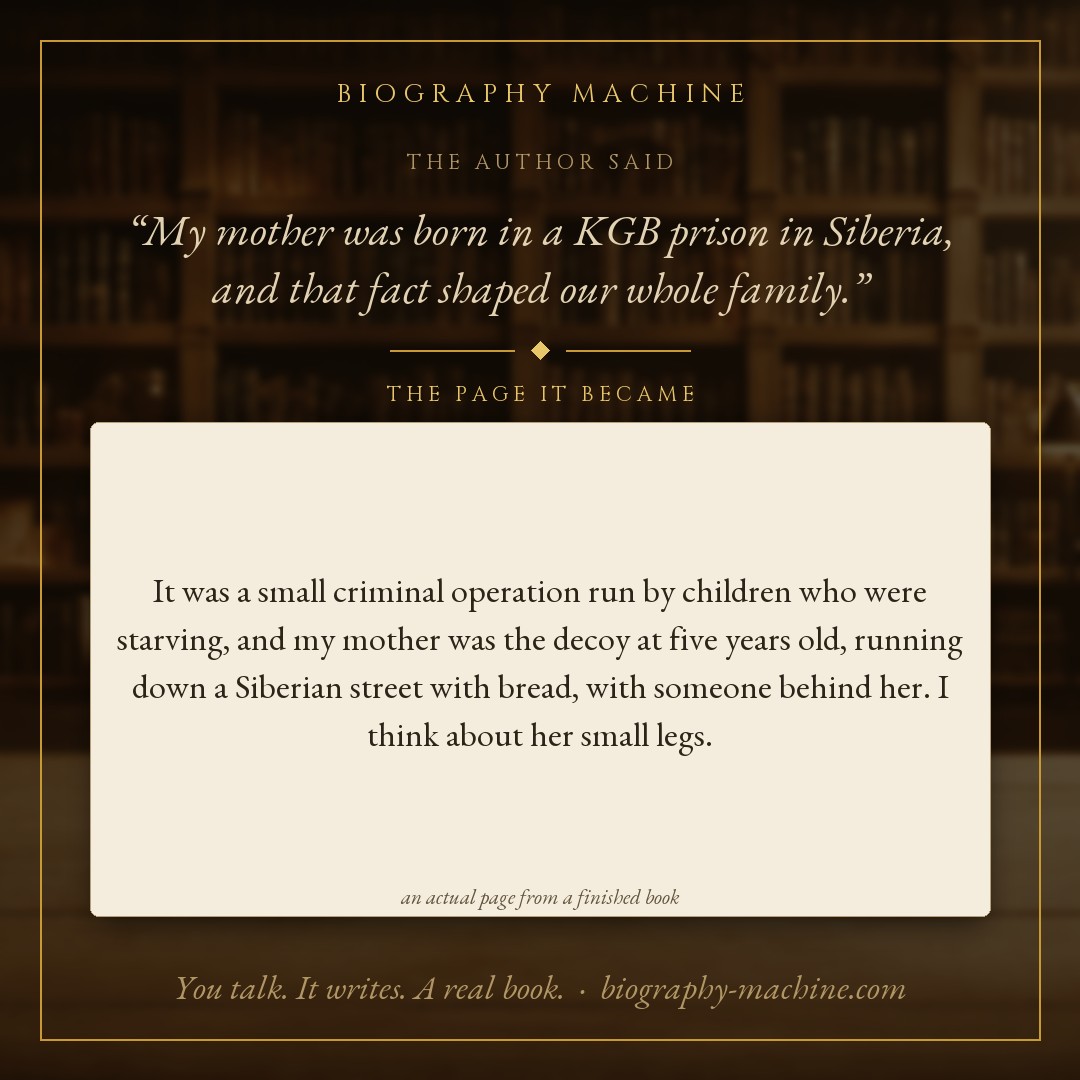
He said one sentence about his mother.
The machine wrote the page you see here: her, five years old, a decoy in a Siberian street, running with bread.
Every fact came from his own spoken words. Nothing invented. That is the rule this whole machine is built on.
You talk. It writes. A real printed book.
biography-machine.com
Both sides are verbatim: what the author said in the interview, next to the page in the finished book. Nothing invented.
No comments yet, say something kind.
The Interview
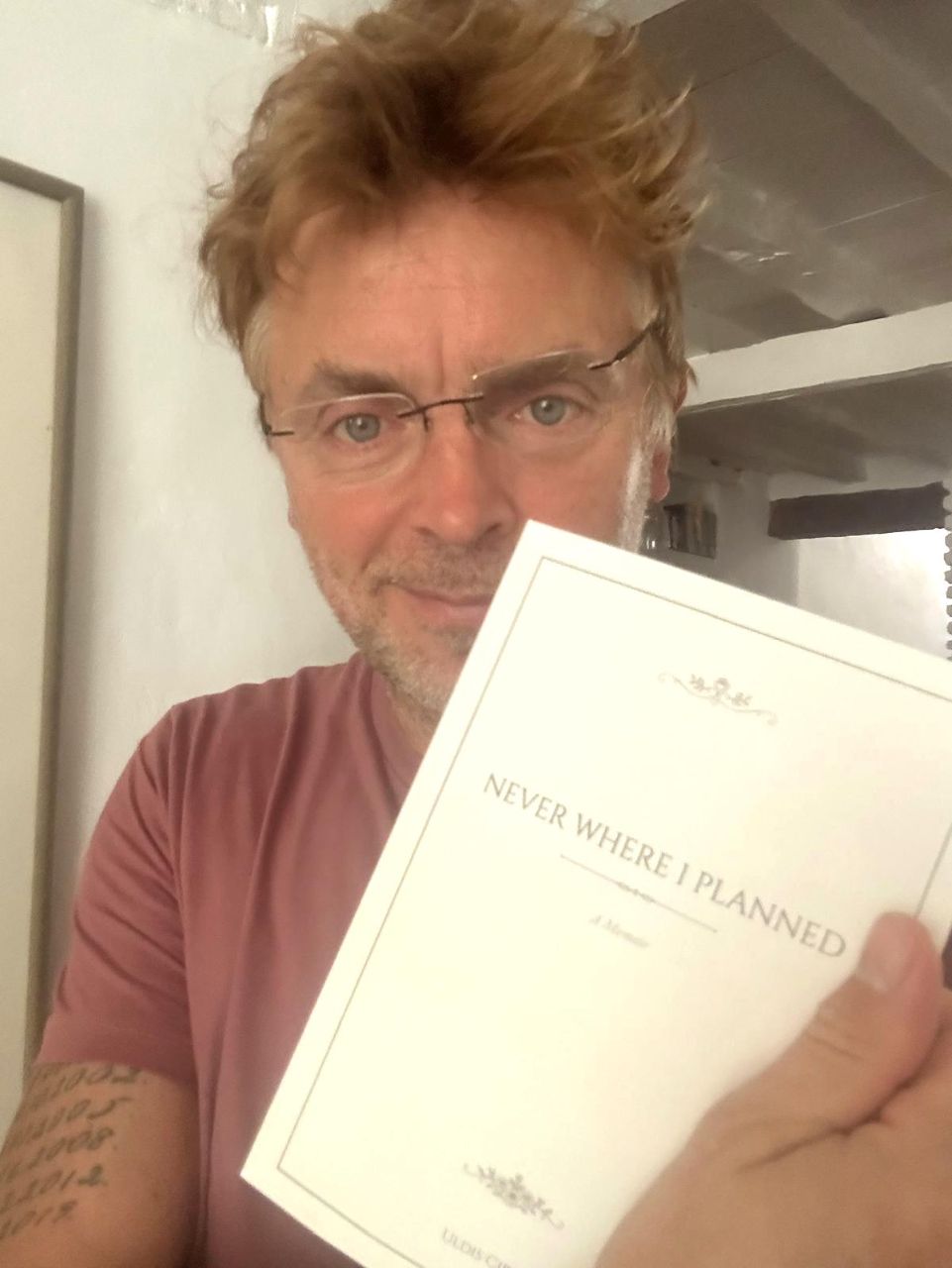
GOT MY BOOK!
Uldis · 22 Jul 2026
No comments yet, say something kind.
The Interview
Here is one story from he book: ONE STONE, WRONG ALTITUDE
Uldis · 22 Jul 2026
I was ten years old in 1984, which means I was exactly the right age to be completely convinced that the best way to solve a disagreement with your closest friend was to throw rocks at each other. Not big rocks. We were not savages. We had rules. You aim for the legs. This was the Geneva Convention of our neighbourhood, agreed upon by two boys who had never heard of Geneva and would not have cared.
The fights were regular. This is important context. It was not as if one afternoon the devil whispered in our ears and suddenly we were throwing things. No, we had developed a whole system. There was an argument, there was an escalation, there were stones, there were legs as the official target zone, and then eventually it ended and we went home for dinner and came back the next day. A beautiful friendship. Very healthy. I cannot recommend it enough.
What happened on this particular afternoon was that the system broke down. I will not say whose fault it was. I will say it was not entirely mine in ways that feel important to establish immediately.
The stone went too high. That is all. One stone, one error of trajectory, and my friend went down like a very small, very dramatic tree. He made a sound I had never heard before. He put his hand to his head. His hand came away with something on it that was not supposed to be outside of a person's head.
I stood there for perhaps two seconds, which felt like the entire length of my life until that point. And then a thought arrived, and the thought was: *I have killed him.*
Now, he was sitting up. He was making noise. These are not, technically, things that dead people do. But I was ten, and ten-year-old boys are not strong on technical distinctions when there is blood involved. The logical part of my brain, the part that would eventually grow up and make films, direct actors, construct scenarios, completely abandoned me and ran off somewhere to lie down quietly. What remained was pure, screaming panic.
I ran. Not to my friend. To his mother.
I want you to understand the distance involved. I ran across the yard, up the stairs, to his apartment door, and I knocked. When she opened the door, I was standing there, breathless, red-faced, with the expression of a person who has just done something irreversible and knows it. And I said, I remember this precisely because it has lived in me for forty years as a monument to human stupidity, I said: "Sorry. I think I killed your son."
She stared at me. I want to give her credit. She did not faint. She did not immediately start screaming. She went through several emotions very quickly, like a woman flipping through television channels, settling briefly on shock, horror, and then something that was possibly just the flat exhaustion of raising boys in Latvia in 1984. She went to find him. He was, as I mentioned, sitting up. Still making noise. Definitively, medically, technically alive.
I do not remember much after that. I think I was sent home. I think I apologised many more times. I think I spent that evening in the specific private hell of a ten-year-old who believes he is a murderer and cannot tell anyone because telling someone would make it more real.
And then the next morning I went to school.
And there he was. My friend. Walking in through the door. With a bandage on his head, white, clean, slightly heroic-looking, the kind of bandage that immediately makes every other boy in the class deeply jealous because it is an artefact of actual, documented adventure. He sat down at his desk. He looked at me. I looked at him.
We were still friends. Just like that. No ceremony, no conversation, no formal reconciliation. In the way that only boys of that age can manage, we simply agreed without speaking that it had happened, he had survived, and we could go back to whatever we had been doing before.
He looked, I have to say, much more interesting than me. He had the bandage. He had the story. People kept asking him what happened and he got to tell
No comments yet, say something kind.
Fragments
Uldis Cipsts · 07 Jul 2026
I was ten years old in 1984, which means I was exactly the right age to be completely convinced that the best way to solve a disagreement with your closest friend was to throw rocks at each other. Not big rocks. We were not savages. We had rules. You aim for the legs. This was the Geneva Convention of our neighbourhood, agreed upon by two boys who had never heard of Geneva and would not have cared.
The fights were regular. This is important context. It was not as if one afternoon the devil whispered in our ears and suddenly we were throwing things. No, we had developed a whole system. There was an argument, there was an escalation, there were stones, there were legs as the official target zone, and then eventually it ended and we went home for dinner and came back the next day. A beautiful friendship. Very healthy. I cannot recommend it enough.
What happened on this particular afternoon was that the system broke down.